
Podcasting is no longer niche. It is mainstream. Businesses use it for thought leadership. Creators use it to build communities. Brands use it to drive engagement. And audiences consume podcasts daily while commuting, working out, or multitasking.
But there is a problem.
Audio alone does not rank well in search engines. If your episode lives only as a sound file, most of its value stays hidden from Google. That is why more creators are choosing to transcribe podcasts to text and publish podcast transcripts alongside every episode.
If your podcast is not transcribed, it is not fully searchable.
Search engines cannot listen to audio. They rely on text. When you publish podcast transcripts, you give Google something to crawl and index. That improves:
Podcasts transcription also improves accessibility. Not every user wants to listen to a full episode. Some prefer to skim, scan for quotes, or jump to key sections.
Beyond SEO and accessibility, transcripts extend the life of your content. A single episode can become:
And when paired with a podcast analytics tool, transcripts become even more powerful. They help you analyze themes, trends, and recurring audience interests.
Also Read: Why You Should Transcribe Podcast to Text for Better SEO
Not all tools that transcribe podcasts to text are equal. In 2026, creators expect more than basic audio to text services.
Here is what separates strong tools from average ones:
Accuracy: The transcript should capture real meaning, not just words. Context matters.
Speed: Processing should happen in minutes, not days.
Speaker Identification: Clear labeling of hosts and guests improves readability.
Multilingual Support: Podcasts increasingly include bilingual conversations.
Searchable Transcript Library: You should be able to search across all podcast transcripts.
Built-in Analytics: A modern tool should function as a podcast analytics tool, not just a transcription engine.
Export and Editing Flexibility: Easy downloads and formatting options are essential for publishing.
DictaAI stands out because it goes beyond basic podcast transcription.
It allows creators to:
Unlike tools that only provide raw text, DictaAI integrates transcription with analytics. It acts as both a transcription platform and a podcast analytics tool.
For creators, marketing teams, and businesses, this matters. Instead of just documenting episodes, you gain insight into what you are actually saying, what topics dominate your conversations, and what content resonates most.
It is ideal for:
The combination of structured transcripts and built-in analytics gives DictaAI a strategic advantage.
There are several AI-powered podcast transcription tools on the market. Many offer:
While these tools can transcribe podcasts to text efficiently, they often stop there. Their limitations may include:
If you only need simple audio to text services, these tools may be enough. But if your goal is SEO growth, analytics, and content repurposing, more advanced platforms like DictaAI provide deeper value.
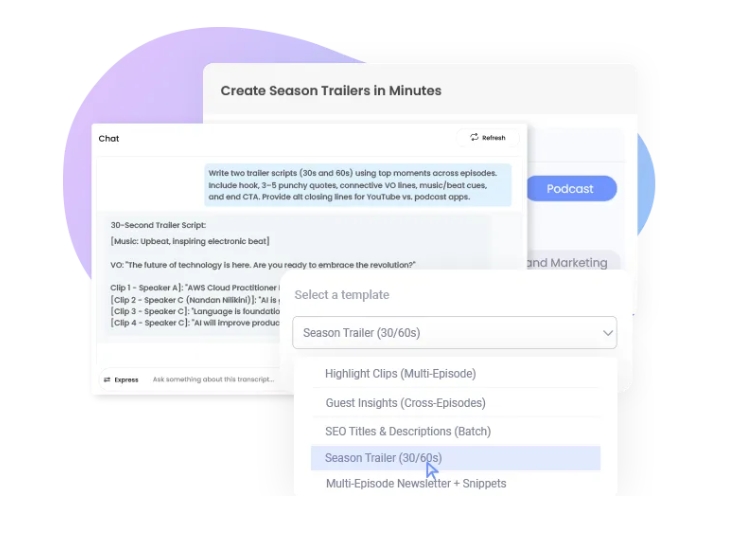
In 2026, transcription is not just about converting speech into written words.
AI-powered podcast transcription tools transform audio into structured podcast transcripts that can be analyzed.
Once your episode is in text format, you can:
A podcast analytics tool built into the transcription platform allows you to move from raw conversation to data-backed content strategy.
AI-powered podcast transcription supports multiple growth strategies.
SEO Optimization: Publishing transcripts helps you rank for keywords like “transcribe podcast to text” and other long-tail queries.
Content Repurposing: Turn episodes into blogs, LinkedIn posts, newsletter segments, or social media captions.
Research and Knowledge Management: Search past episodes to revisit insights, guest quotes, or recurring themes.
Team Collaboration: Share searchable transcripts internally for planning and strategy alignment.
When podcast transcripts are organized and searchable, they become long-term digital assets.
Before selecting a platform, ask yourself:
Evaluate tools based on:
Tools that only convert audio may save time, but platforms that combine transcription with analytics deliver strategic value. That is why many creators prefer solutions like DictaAI.
To get the most out of your podcast’s transcription:
Even with AI, creators sometimes limit their results by:
Podcasting is growing, and so is competition. Simply publishing audio is no longer enough.
AI-powered podcast transcription allows creators to transcribe podcasts to text efficiently, improve discoverability, and unlock deeper insights. Modern tools combine transcription with analytics, transforming conversations into searchable, strategic assets.
The future is not just about converting audio. It is about understanding it.
If you want to maximize SEO, repurpose content effectively, and extract real insights from your episodes, choose a platform that does more than basic audio to text services.
Try DictaAI and experience smarter podcast transcription powered by analytics.
It converts spoken audio into written text using either manual typing or AI-powered speech recognition technology.
Leading tools include AI-powered platforms like DictaAI that combine transcription with analytics and searchable transcript libraries.
Modern AI transcription services offer high accuracy, especially when trained on diverse speech patterns and supported by contextual understanding.
Yes. AI-powered tools can automatically transcribe podcasts to text within minutes.
Advanced platforms like DictaAI function as a podcast analytics tool, allowing users to analyze transcripts for themes, trends, and insights.


Comments
Glynnis Campbell
This is a test comment!