

Market research doesn’t look like it used to. In 2026, interviews happen across time zones, focus groups meet on Zoom, and global panels generate hours of recorded conversations every day. The insight is there, but so is the overload. Research teams are drowning in audio and video while stakeholders expect faster answers than ever.
Traditional manual market research transcription services simply can’t keep pace. Turning recordings into usable insights takes too long and costs too much. That’s why AI transcription services are no longer optional. They’ve become essential for scaling qualitative research without slowing it down.
There are several challenges of Modern Qualitative Research:
Qualitative research has scaled significantly. Companies conduct more interviews, run more focus groups, and gather more participant feedback than ever before.
Research teams are often working with:
Traditional qualitative research transcription methods come with several limitations.
In 2026, research teams need solutions that move as fast as their data grows.
AI transcription services now generate research interview transcriptions in minutes instead of days. Advanced speech recognition models accurately handle accents, varied speaking speeds, and even overlapping dialogue. While AI provides fast, precise solutions, human review still plays a critical role in refining the final output. AI systems are highly efficient, but they may occasionally miss certain nuances or context-specific details. A quick human review ensures the transcriptions remain contextually accurate and reliable.
With this hybrid approach, combining AI's speed and human oversight, research teams can enjoy faster turnaround times without sacrificing accuracy. Modern AI models, trained on diverse datasets, also process dialects, industry terminology, and conversational nuances with exceptional precision, enhancing both speed and quality.
AI transcription services now generate research interview transcriptions in minutes instead of days. Advanced speech recognition models accurately handle accents, varied speaking speeds, and even overlapping dialogue.
Researchers can upload a recording and receive a structured transcript almost instantly. Faster turnaround leads to faster analysis, which ultimately drives better decisions.
Modern AI models are trained on diverse datasets, enabling them to process dialects, industry terminology, and conversational nuances with greater precision.
Global research frequently involves bilingual or multilingual participants. Interviews often shift naturally between languages, especially in emerging markets.
AI-powered market research transcription services are designed to manage hybrid conversations seamlessly. Whether participants switch languages mid-session or use regional dialects, AI adapts more effectively than traditional systems.
This flexibility allows global research teams to run studies confidently without worrying about transcription limitations.
Scalability is one of the biggest advantages of AI-driven transcription.
Researchers can bulk upload interviews and focus group recordings while maintaining consistent formatting across transcripts. All files are securely stored in organized, cloud-based libraries.
Instead of managing scattered documents, teams gain a centralized, searchable archive that supports collaboration and long-term knowledge management.
Transcription is only the beginning.
Modern AI tools for market research go beyond simple speech-to-text conversion. They automatically analyze transcripts to identify recurring themes, topics, and keywords.
Instead of manually coding interviews line by line, researchers can detect patterns across dozens of conversations instantly. This speeds up thematic analysis and significantly reduces manual effort.
Emotional tone plays a crucial role in qualitative research. AI tools can now detect positive, negative, and neutral sentiment within research interview transcription data.
By analyzing tone at scale, researchers can uncover perception trends across customer segments or product experiences. This moves analysis beyond surface feedback and into deeper emotional insight.
AI can generate context-aware summaries of entire interviews or focus groups within minutes.
Researchers can quickly produce executive-ready insight reports that are easy to share with stakeholders. This bridges the gap between raw qualitative research transcription and clear, actionable strategy.
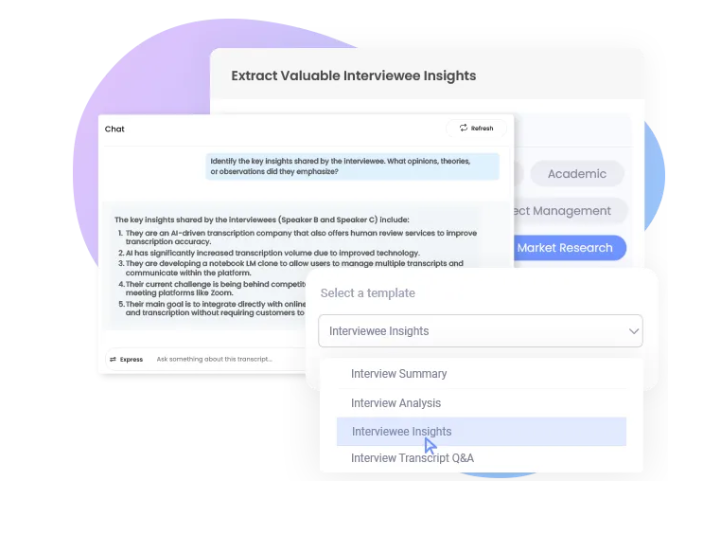
DictaAI transforms qualitative research transcription from a manual task into an intelligent, insight-driven workflow.
DictaAI delivers fast, accurate AI transcription services built specifically for research workflows. Interviews and focus group recordings can be uploaded and converted into structured transcripts within minutes.
Each transcript is securely stored, fully searchable, and organized into a centralized knowledge base. Flexible export options ensure seamless integration with analysis tools and reporting platforms.
DictaAI goes beyond basic qualitative research transcription by combining transcription with built-in analytics.
Researchers can automatically extract themes, identify recurring patterns across interviews, and generate insights using custom prompts. Instead of manually reviewing transcripts line by line, teams can query their data intelligently and uncover insights faster.
This shifts research interview transcription from documentation to actionable intelligence.
The platform is designed for speed and simplicity.
Upload recordings → Generate transcripts → Run AI analysis → Refine insights → Export reports
This streamlined workflow reduces manual effort and allows research teams to focus on interpretation, strategy, and decision-making rather than administrative processing.
The impact of AI in market research transcription services is both immediate and measurable. Turnaround times shrink from days to minutes, operational costs decrease as manual effort is reduced, and reporting cycles move significantly faster.
At the same time, theme identification becomes more comprehensive, as AI can analyze patterns across interviews at scale. Most importantly, decision-making improves. When insights are delivered quickly and accurately, organizations can respond to market shifts with greater clarity and confidence.
Traditional Qualitative Research Transcription | AI Qualitative Research Transcription |
| Turnaround times measured in days | Transcripts generated in minutes |
| High cost per audio hour | Lower cost, especially at scale |
| Limited ability to handle bulk projects | Easily processes large volumes of interviews |
| Text output only | Built-in theme detection, sentiment analysis, and summarization |
| Static files stored separately | Searchable, centralized transcript library |
| Manual coding required for analysis | Automated pattern recognition and insight generation |
The difference is clear: AI elevates qualitative research transcription from simple documentation to scalable, insight-driven intelligence.
Looking ahead, AI-driven thematic coding will become more advanced. Predictive insight generation will help researchers anticipate trends before they fully emerge.
Integrated dashboards will combine AI transcription services with analytics, visualization, and reporting tools in unified platforms.
Market research transcription services will no longer operate separately from analysis tools. They will become part of a complete research intelligence ecosystem.
Also Read: The 6 AI Capabilities Powering Modern Business Intelligence in 2026
In 2026, transcription is no longer just about converting audio into text.
AI tools for market research transform voice data into structured insight. Research interview transcription becomes the foundation for deeper qualitative analysis.
Organizations that leverage AI transcription services gain faster reporting, stronger thematic clarity, and more informed strategic decision-making.
DictaAI represents this next evolution. By combining qualitative research transcription with integrated analytics and intelligent workflows, it moves beyond documentation and into research intelligence.
Market research transcription services convert recorded interviews and focus groups into text. In 2026, they are critical because research volume has increased significantly, and fast, accurate transcription supports quicker analysis and decision-making.
AI transcription services automate research interview transcription, reduce turnaround time, lower costs, and enable scalable analysis through advanced speech recognition and automated formatting.
Yes. Modern AI tools for market research can detect themes, analyze sentiment, cluster keywords, and generate summaries directly from transcripts.
Advanced AI systems trained on diverse datasets provide high accuracy levels suitable for professional qualitative research, especially when combined with researcher review.
Accurate qualitative research transcription ensures that insights are documented clearly, patterns are identified effectively, and stakeholder reporting is based on reliable data.


Comments
Glynnis Campbell
This is a test comment!